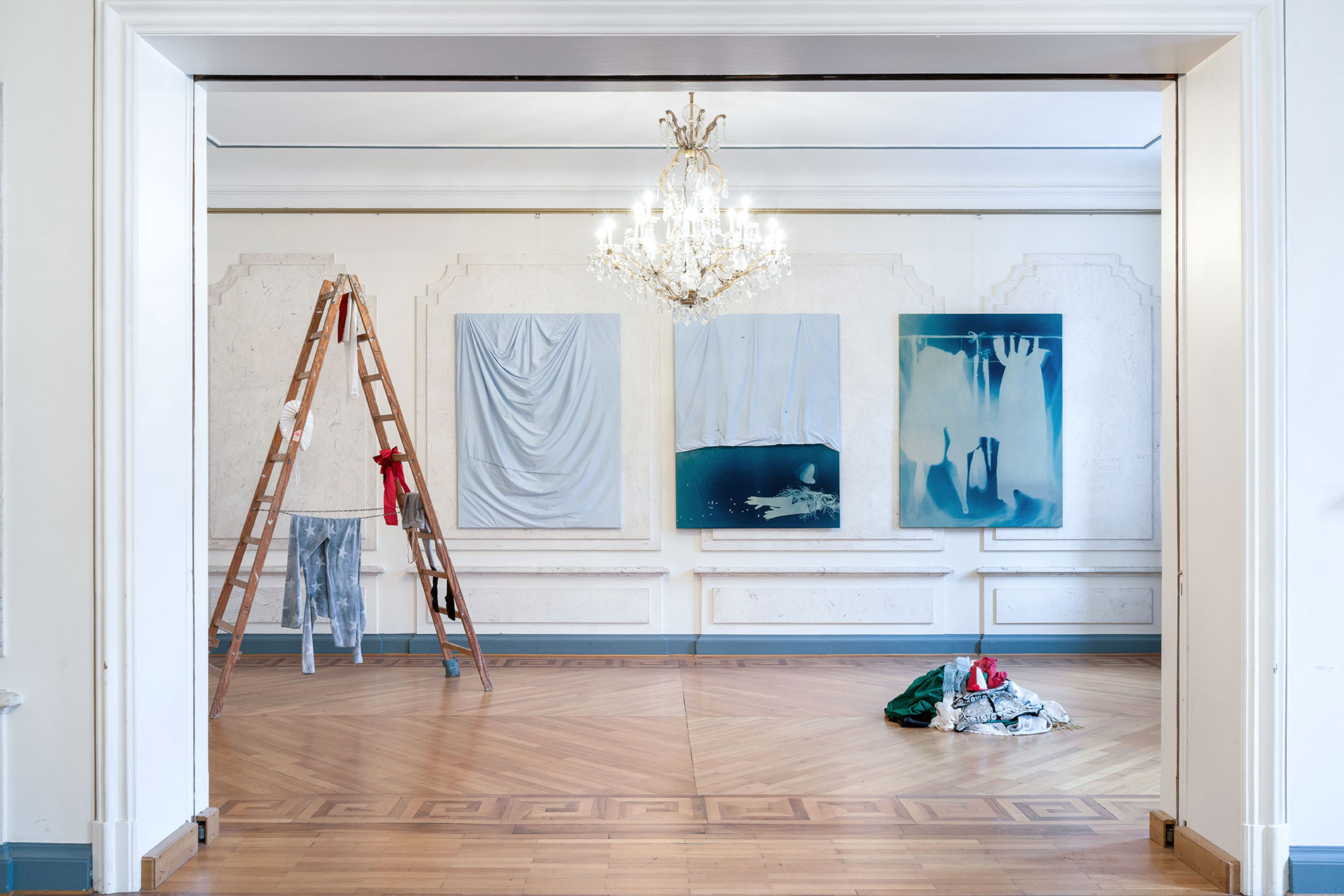
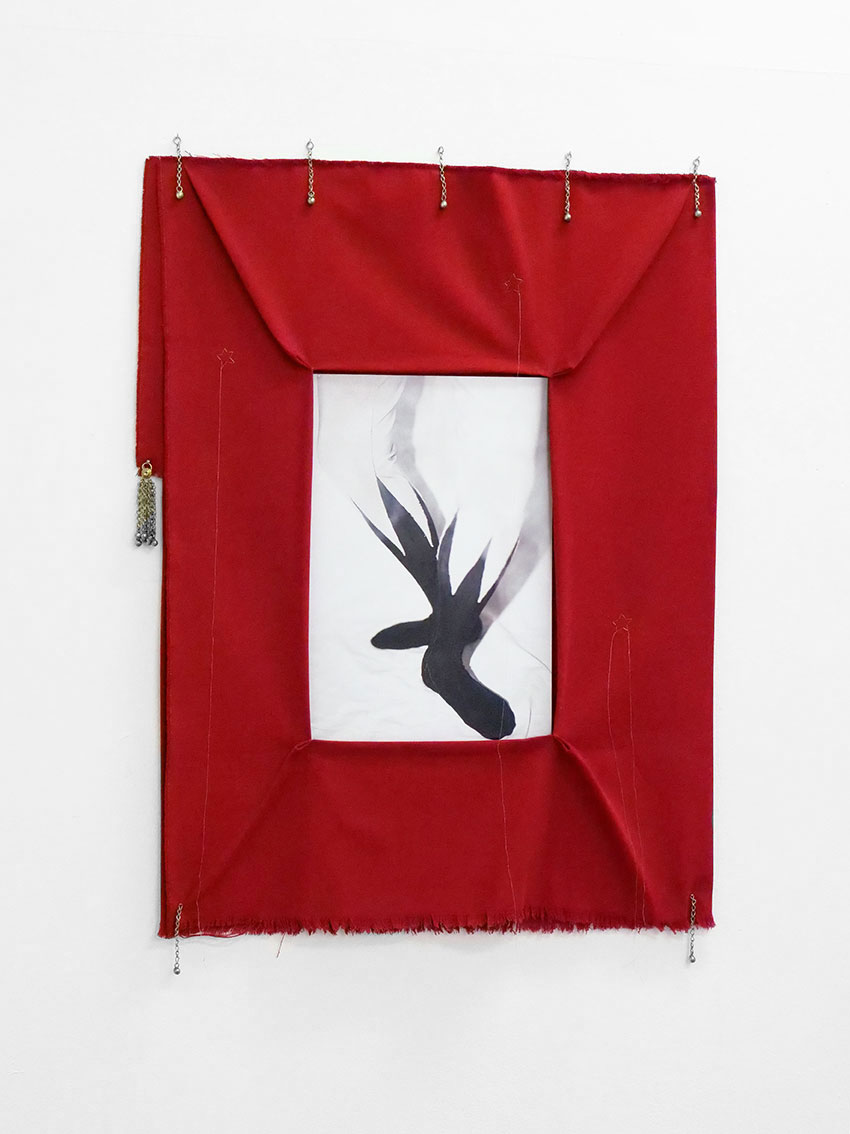
'All Traces Tell Tales', 2024
Installation, sculptures, and prints on cotton fabric, embroidery, cyanotype.
A body of works co-created in collaboration with Alina Röbke, with the support of Kultursommer Rheinland-Pfalz.
Residencies in Palermo, Naples (IT), Marseille (FR), and Mainz (DE) led to an exhibition cycle at KWR40, Mainz, Germany and at the Institut Français de Mainz, Germany, by invitation of the PART collective, curated by Antonio Quint Vila. (French title : 'Les Traces, (Un conte').
Emma Tholot lives and works between Paris and Marseille as a visual artist. Her practice is rooted in both everyday and ancestral rituals, in traditions and the superstitions of the Mediterranean. Alina Röbke lives and works between Cologne and Mainz and explores places, objects, and cultural contexts using light-sensitive paintings. Their collaboration began in 2022 during their simultaneous residency in Palermo, Italy by the Institut Français Italia.
While Röbke responds to site-specific conditions through a momentary, formal, and visual process with her materials and body, Tholot collects visual and sensory impressions over time and retells them through precise concepts, stories, and images. In 2024, they developed a joint body of work that resulted from an artistic-cultural research process conducted across various locations: Marseille, Napoli, Palermo and Mainz.
In Marseille, they made a precise research on clowns and carnivals in Europe during the last century. They connected to textures, materials, production know-how and learned techniques. The conditions of costume production through the centuries (low candle light, unstable trailers, mending and patching) inspired their process.
During the travels through Italy, the use of fabric left a significant mark on the body of work. Sun-bleached curtains on the streets, generous folds, and especially the colours serve as references within the paintings, which visually connect to the creation of costumes. The work delves into the role of clowns as both real historical figures, such as 19th-century Jean Baptiste Auriol, and as archetypal abstract representations. The formal language of circus and carnival, can be clearly interpreted across diverse cultural contexts and is adapted by Tholot and Röbke.
'All Traces Tell Tales' is constructed as a mosaic of quotations, which is visually realized in a spatial installation featuring artifacts and paintings, encapsulating the connections they discovered between the cultures of France, Italy and Germany.
works All Traces tell Tales